
Vladimir Horowitz
Learning the layout of the keyboard is like taking a treasure map to the end of the rainbow of musical expression. This chapter walks you through the structure of the piano keyboard to show how the white keys and black keys create a repeating pattern that serves as the groundwork for every melody you’ll play. Using narratives and active exercises, you’ll learn how to maneuver through this musical terrain with purpose.
Discovering the Keyboard
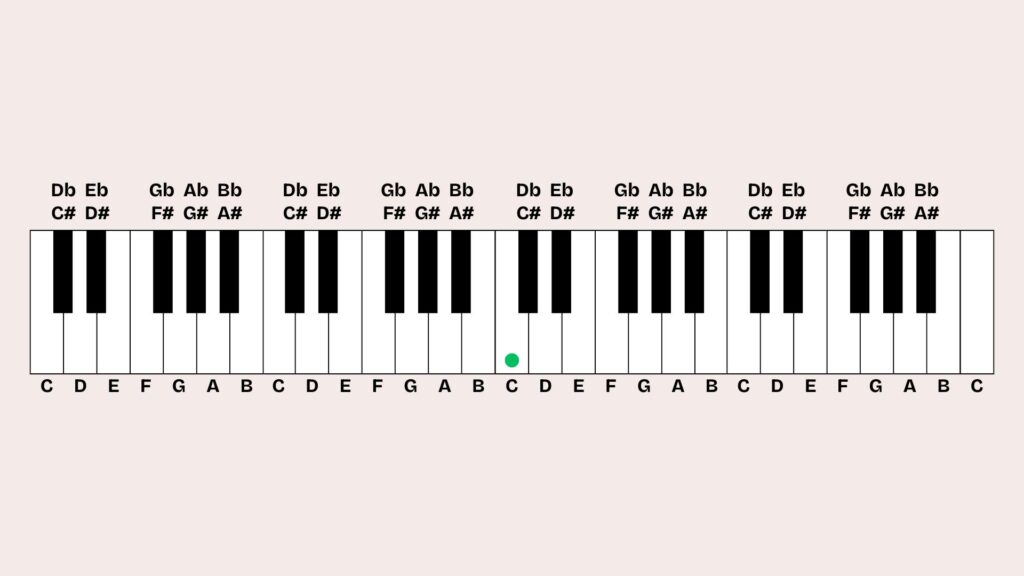
The first time you sat in front of a piano, with its line of keys stretching before you, the promise of endless tunes lying in wait. With each key comes a note, and combined, they forge a cosmos of sound. The black and white keys on the piano keyboard follow a recurring pattern. The seven white keys represent the natural notes that everyone knows, A, B, C, D, E, F, and G, and the black keys represent the sharps (#) and flats (b) in groups of two and three.
The Middle C is situated near the center of the keyboard. The first time I ever identified Middle C was like finding buried treasure on a map of the universe. That moment intrigued me and helped me figure out all the details of the layout.
Breaking Down the Pattern
The white keys are straightforward and repeat in a cycle: A, B, C, D, E, F, and G. This cycle is the backbone of Western music and serves as a guide for understanding musical scales.
Black keys are placed between white keys A & B, C & D, D & E, F & G, and G & A. The black keys are arranged in a distinctive pattern of two and three. The black key in between A and B is represented by A# or Bb. This grouping not only adds color to the music but also helps you quickly identify your place on the keyboard. For example, the note immediately to the left of the two black keys is always C.
Instead of reading the notes like A-B-C-D-E-F-G, read it starting from C like C-D-E-F-G-A-B. I am sure the black key patterns in group of two and three is now prominently visible. So, follow the repetition of notes from C to B including black/ sharp notes on the keyboard.
Interactive Exercise: Identify the Notes
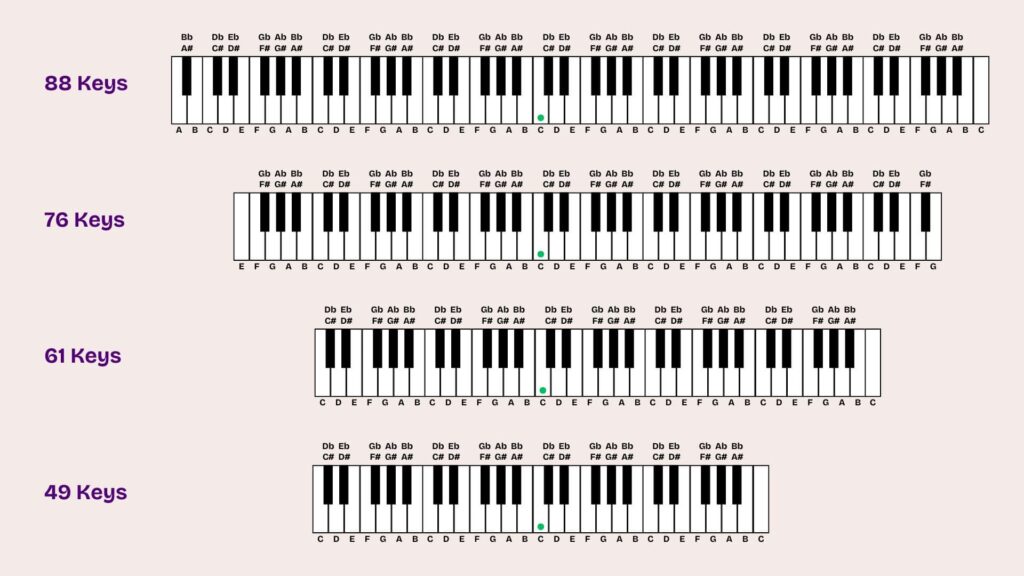
- Locate Middle C: Go sit at your piano and find the group of two black keys towards the middle. Mark this white key to the left of the two notes in your practice journal – this is called Middle C.
- Map the Pattern: Take a scan of the keyboard with your fingers and yes, you should go through and identify and name the white keys from C to the next C – note the consistent pattern and see how these white keys are organized.
- Challenge Yourself: Finding a specific note (for example, E or G) with eyes closed. Validate your accuracy by opening your eyes. This Exercise improves your comfort with the layout and helps muscle memory.
Write down your experience. What note was the easiest to find? Did you notice any new patterns or markers along the way?
Bringing It All Together
In this chapter:
- You have navigated the structure of the piano keyboard, learning both white and black key names and locations.
- Found essential waypoints such as Middle C that are your guideposts.
- You have practiced with interactive exercises that are aimed at helping you become accustomed to the keyboard and developing the muscle memory necessary for typing.
At the beginning of every practice, spend a few minutes reviewing the (physical) layout of the keyboard. Now picture the pattern in your brain and take the interactive exercises to help you practice. As you become more familiar with them, they become a part of your muscle memory, and you can concentrate less on the basics and more on making music.
Gain familiarity with the keyboard layout, it is your first step to keyboard mastery. Best of luck – just remember this map, each note your fingers find a step closer to your sound.
Good luck, and may each keystroke unlock new possibilities!