
“A piano is a beautiful mechanism, but it’s also a magical one.”
Martha Grimes
Playing chords transforms individual notes into a rich, full sound that supports almost every song. This chapter will teach you how to use simple chords to accompany easy songs. We will explore how chords create harmony, share interactive exercises to master smooth transitions, and offer a few notes on famous, easy-to-learn songs that you can start playing right away.
The Power of Chords in Music
Harmony is built on chords, and chords are built from notes. When you strike a chord you are playing multiple notes at once, producing a expressive, fuller sound than any single melody can provide. Whether you are accompanying your favorite melody or strumming a tune on the piano, chords add emotion, depth, and structure to your playing.
First time I played a simple chord progression; it felt like painting with sound. The transformation from a series of isolated notes into a flowing, harmonized song was magical, and it opened my eyes to the endless creative possibilities that chords offer.
Building and Playing Basic Chords
We covered major and minor chords earlier; in this chapter we will focus on applying those chords in a musical context. The key is to practice switching between chords smoothly and maintaining a steady rhythm.
Tips for Smooth Chord Transitions:
- Finger Positioning: Keep your fingers close to the keys for a quicker transition.
- Practice Slowly: Start with slow, deliberate movements before increasing your speed.
- Use a Metronome: Maintain a steady beat to ensure your chord changes are rhythmic.
Interactive Exercise
Choose two basic chords (for example, C major and G major) and practice switching between them. Play each chord for four beats, then switch. Repeat until your transitions become seamless. Record your progress in your practice journal, then note any challenges and improvements.
Notes on Famous, Easy-to-Learn Songs
Learning simple songs using chords is a great way to put your skills into practice. Here are a few well-known tunes with basic chord progressions to get you started:
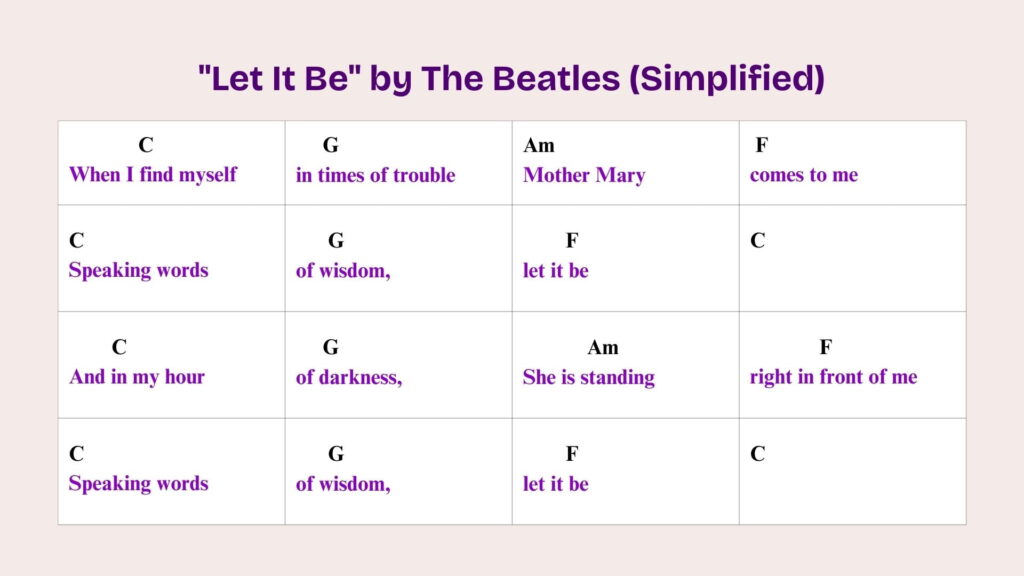
“Let It Be” by The Beatles (Simplified)
- Chord Progression (Key of C): C – G – Am – F
- “Am” is A minor
- Notes:
- C Major: (C, E, G)
- G Major: (G, B, D)
- A Minor: (A, C, E)
- F Major: (F, A, C)
- Practice Tip: Strum each chord for a full measure and listen to how the progression creates a soothing, familiar sound.
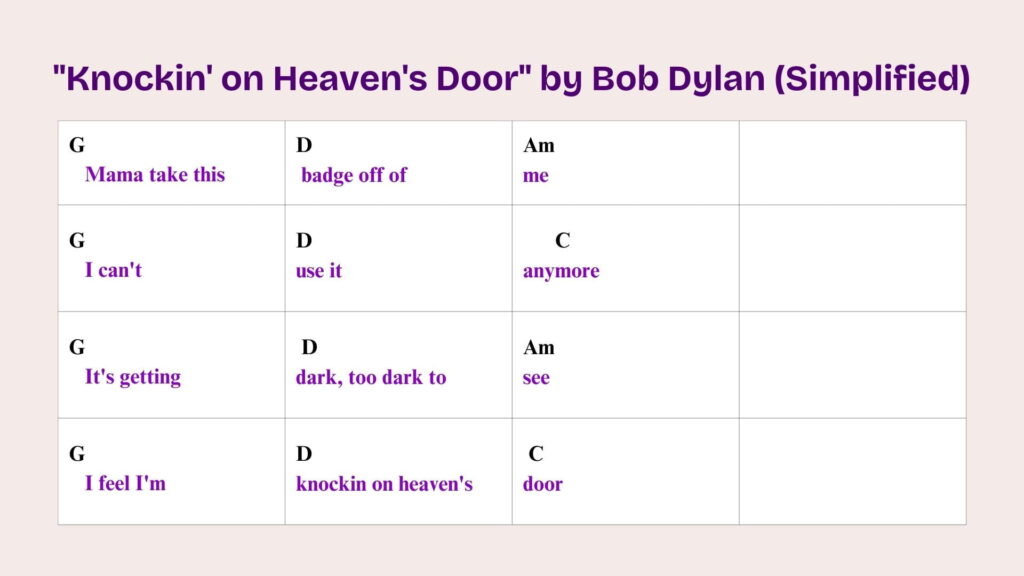
“Knockin’ on Heaven’s Door” by Bob Dylan (Simplified)
- Chord Progression (Key of G): G – D – Am – G – D – C
- Notes:
- G Major: (G, B, D)
- D Major: (D, F#, A)
- A Minor: (A, C, E)
- C Major: (C, E, G)
- Practice Tip: Focus on making your chord changes smooth. Once comfortable, try singing along to reinforce the rhythm and melody.
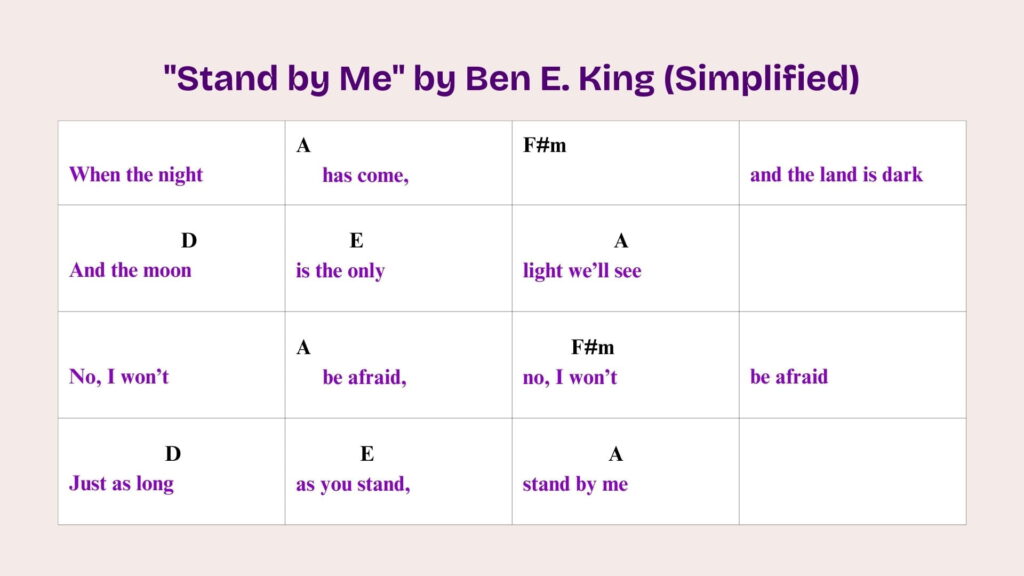
“Stand by Me” by Ben E. King (Simplified)
- Chord Progression (Key of C): A – F#m – D – E – A
- Notes:
- A Major: (A, C#, E)
- F# Minor: (F#, A, C#)
- D Major: (D, F#, A)
- E Major: (E, G#, B)
- A Major: (A, C#, E)
- Practice Tip: Play these chords in a loop and experiment with dynamics—try playing softly at first, then build up the volume for a more emotional effect.
Interactive Chord Exercises
Exercise: Chord Progression Practice
- Step 1: Select a chord progression from one of the songs above.
- Step 2: Practice each chord individually until you can play them cleanly.
- Step 3: Begin to practice the transitions by playing each chord for four beats, gradually increasing your tempo.
- Reflection: Record your observations. Which chord change feels most challenging? How can you adjust your finger positioning to improve?
Exercise: Accompanying a Simple Melody
- Step 1: Choose a simple melody you’ve already learned.
- Step 2: Identify which chords match the melody’s harmony.
- Step 3: Play the chords along with the melody. This exercise helps bridge the gap between melody and harmony, deepening your musical understanding.
Bringing It All Together
Highlights of learning from this chapter.
- Master Basic Chords: Reinforced your understanding of major and minor chords.
- Smooth Transitions: Developed the ability to switch between chords fluidly.
- Apply in Context: Practiced simple, famous songs using basic chord progressions.
I recommend you keep about 15 to 20 minutes practice session for chord exercises and playing along with simple songs. As you practice, these exercises will improve your music.
With better understanding of chord, you are building a bridge between the technical aspects of piano playing and the art of musical storytelling. Embrace the journey of learning these simple songs and let each chord progression inspire you to create your own musical masterpiece. Remember, even the simplest tune can transform your music and bring endless joy.
Happy practicing and keep up with your musical journey!