
Wassily Kandinsky
Chords transform individual notes into vibrant expressions of harmonics. This chapter will take you through the mystery of the major and minor triads, teach you how to construct them and even how to play them in inversions.
The Story Behind Chords
Imagine sitting down in front of a piano for the first time, tentatively pressing a single key. Now imagine the instant you hit three notes at once – a release of sound in which the resonance saturates the room with warmth or yearning. That’s the power of a chord.
- Major chords sound bright and happy, like the sun breaking through clouds on a happy morning.
- Minor chords tend have a tinge of melancholy, conjuring up wistful memories and strong feelings.
When you discover the sound of a C major chord, it opens up a secret door to the wealth of human creativity. You are learning new chords, and, with it, you are adding new colors to your palette.
Understanding Major and Minor Triads
What Is a Triad?
A triad is a set of three notes played together:
- Root: The starting note.
- Third: The note a third above the root.
- Fifth: The note a fifth above the root.
Major Chords
- Formula: Root + Major Third + Perfect Fifth
- Sound: Bright, happy, and full of energy.
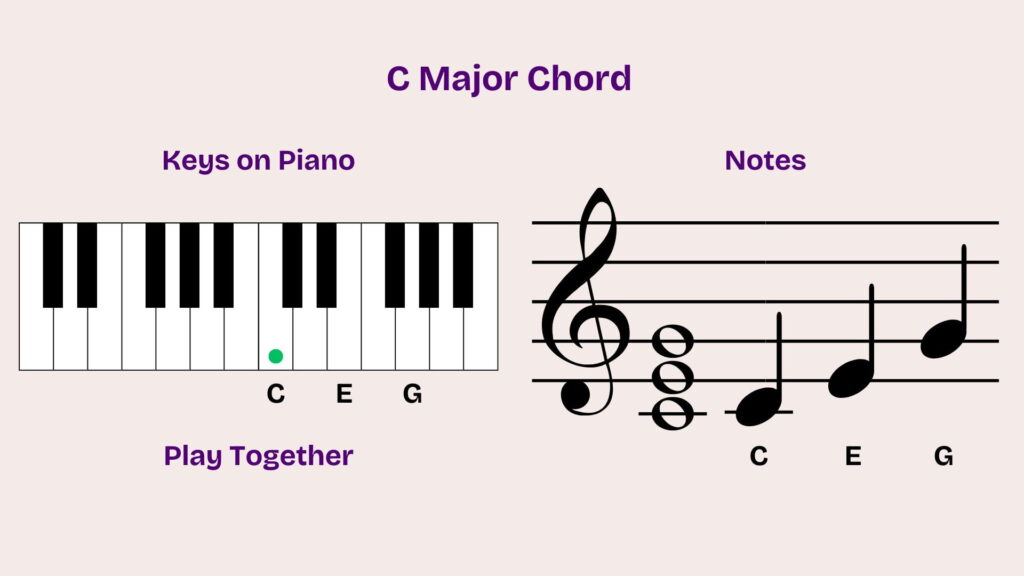
- Example: C Major (C, E, G). Place your thumb on C, your middle finger on E, and your little finger on G. Strum these keys simultaneously and listen to the uplifting sound.
Minor Chords
- Formula: Root + Minor Third + Perfect Fifth
- Sound: Mellow, reflective, and sometimes bittersweet.
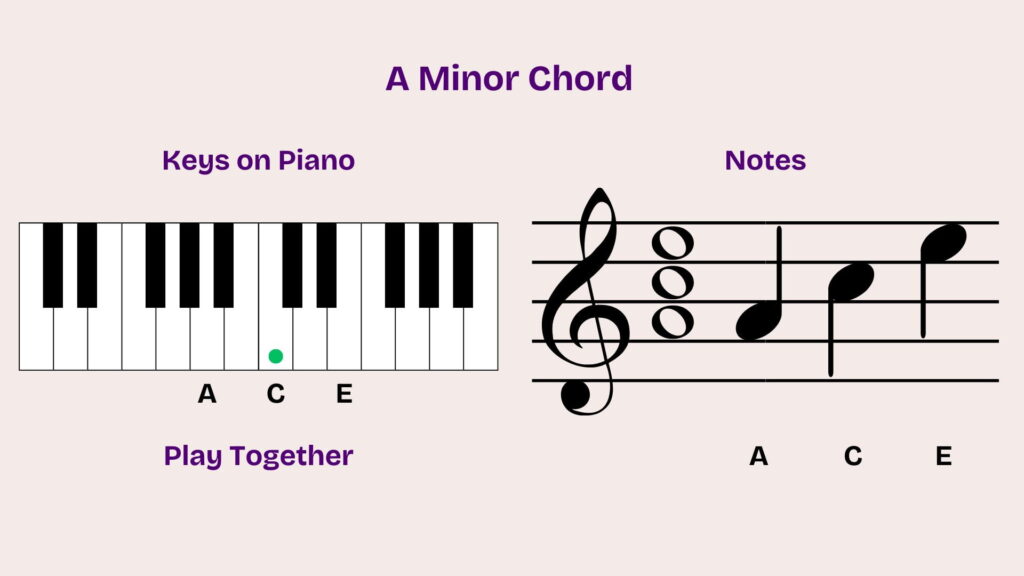
- Example: A Minor (A, C, E). Using similar finger placement, find A on your keyboard, then C, and then E. Play them together to experience a more introspective mood.
Interactive Exercise: Building Your First Chords
Let’s perform this step-by-step activity:
- Locate the Root: Choose a root note (for example, C for a C major chord).
- Find the Major Third: Count four half steps (or keys) to the right of the root. For C, this is E.
- Find the Perfect Fifth: Count seven half steps from the root. For C, this gives you G.
- Play Together: Play C, E, and G simultaneously. Listen carefully to the harmonious sound.
Write down your experience in your practice journal. What feelings did the chord evoke? Did you notice any differences when comparing the bright sound of a major chord to a minor chord?
Choose a different root (say, A for A minor). Find the minor third (three half steps above A) and the perfect fifth (seven half steps above A). Play A, C, and E together and note the emotional contrast.
Exploring Chord Inversions
Chord inversions are simply different ways to arrange the same notes of a chord. They allow you to play chords smoothly and add variety to your music.
What Are Inversions?
- Root Position: The root note is the lowest note.
- First Inversion: The third is the lowest note.
- Second Inversion: The fifth is the lowest note.
Example with C Major:
- Root Position: C (lowest), E, G
- First Inversion: E (lowest), G, C
- Second Inversion: G (lowest), C, E
Interactive Exercise: Cord Inversions
- Practice playing the C major chord in its root position. Then, shift your hand to play the first inversion followed by the second inversion.
- Experiment with the sound of each inversion – notice how the color and balance of the chord changes with each variation.
Bringing It All Together
Let’s recap the key learnings in this chapter:
- Built Major and Minor Triads: The formulas and practice constructing chords on your keyboard.
- Explored Chord Inversions: How inversions provide smoother transitions and add variety to your playing.
- Interactive Exploration: Took up some exercises that allow you to build chords, play them in different positions, and reflect on their emotional impact.
Spend at least 15 minutes during your practice session dedicated solely to chords. Alternate between major and minor chords, and experiment with inversions. Use a mirror or record your practice to observe how your hand positions and transitions improve over time.
Remember that every chord has a unique meaning and feeling as you incorporate them into your playing. Building and inverting chords improves your technical proficiency and strengthens your emotional bond with the music. Allow each chord you play to demonstrate your increasing proficiency and serve as a springboard for more intricate musical explorations.
As you embrace the basics of major and minor chords, your musical vocabulary will grow and delve into the fascinating realm of chord inversions. Savor the experience, take risks, and let your newly discovered harmonies to lead you to countless creative opportunities.
I hope you enjoy practicing and become closer to the essence of music with each chord you play!