Kelsey Grammer
We know that the foundation of music is Scales! They are the equivalent of the alphabet of sound, establishing the groundwork for melodies, improvisations and technical mastery. In this chapter, we will cover the first two most important scales that pianists must be aware of, which are the C major and G major scales. You’ll learn the ins and outs of scales, build fingerings that set you up as a pianist for life.
The Role of Scales in Piano Playing
I want you to think of learning a new language. And as there is a vocabulary and grammar that allows you to express yourself clearly, there are scales that give you the tools to express yourself musically. SCALE PRACTICE Building finger and hand strength, coordination and musical structure. You spend more time playing through exercises that make with fluidity, technique and creativity come easier.
In the beginning, scales were just the same thing over and over to me as well. Yet as I kept going, I realized the fluency of my playing and confidence to approach more difficult works expanded tremendously. Scales became the real backstage pass to mastery.
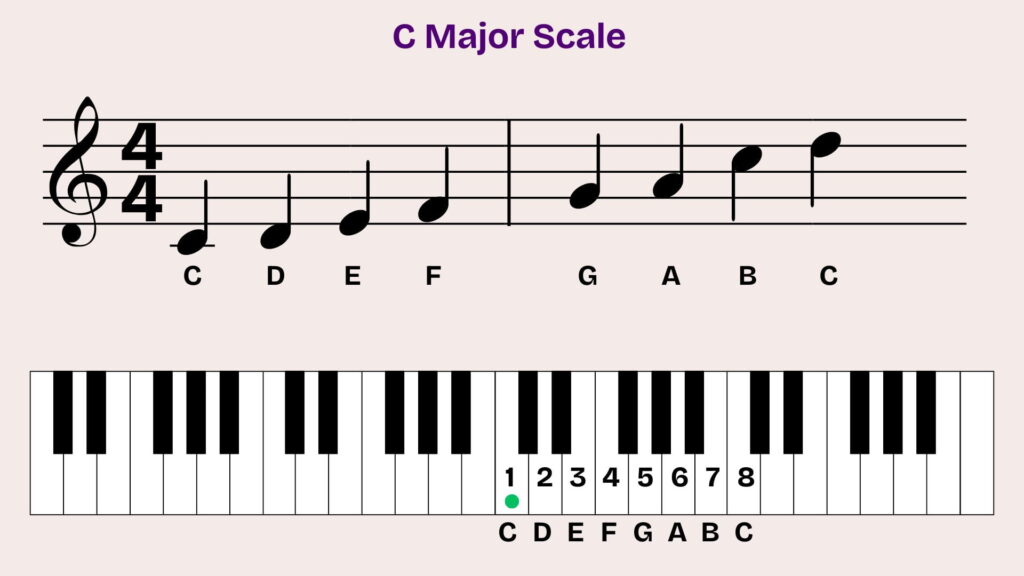
Understanding C Major Scale: The Foundation of Simplicity
The C major scale is often the first scale taught because it contains only natural notes (no sharps or flats). Its simplicity makes it an ideal starting point:
- Notes: C, D, E, F, G, A, B, C
- Fingerings (Right Hand): 1 (thumb) on C, 2 on D, 3 on E, then cross the thumb under for F (1), followed by 2 on G, 3 on A, 4 on B, and 5 on C.
- Fingerings (Left Hand): 5 on C, 4 on D, 3 on E, 2 on F, 1 on G, then cross the 3 over for A, 2 on B, and 1 on C.
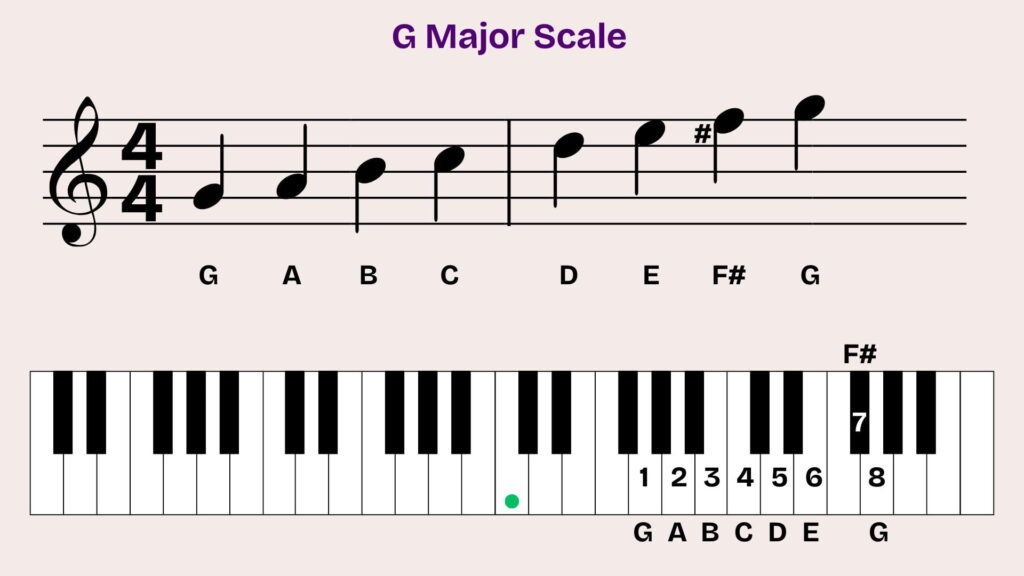
Understanding G Major Scale: Introducing a Sharp Element
Moving on to the G major scale, you’ll notice one sharp in its structure. This scale adds a new layer of challenge and musical color:
- Notes: G, A, B, C, D, E, F#, G
- Fingerings (Right Hand): 1 on G, 2 on A, 3 on B, 1 on C (crossing the thumb under), then 2 on D, 3 on E, 4 on F#, and 5 on G.
- Fingerings (Left Hand): 5 on G, 4 on A, 3 on B, 2 on C, 1 on D, then cross the 3 over for E, 2 on F#, and 1 on G.
Interactive Exercises: Bringing Scales to Life
Exercise 1: Slow, Mindful Practice
- Step 1: Begin by playing the C major scale slowly, paying attention to your fingerings and the even distribution of sound.
- Step 2: Repeat the scale several times, gradually increasing your speed while maintaining accuracy.
- Step 3: Switch to the G major scale and apply the same mindful practice. Focus on the transition when your fingers reach the F#.
- Journal: Record any challenges you encounter. Which scale feels more natural? How does the presence of a sharp note in G major affect your playing?
Exercise 2: Rhythmic Variations
- Step 1: Choose a comfortable tempo and play each scale using different rhythmic patterns (e.g., long-short-long-short).
- Step 2: Experiment with dynamics—start softly and gradually increase volume, then reverse.
- Journal: Reflect on how changing the rhythm and dynamics impacts the musicality of your scale practice. What patterns feel most inspiring to you?
Exercise 3: Connecting Scales to Musical Pieces
- Step 1: Find a simple piece that uses the C major scale or G major scale.
- Step 2: Identify passages in the piece where scale patterns appear and play them separately.
- Journal: Note how scales serve as a bridge between technical exercises and actual music performance. How does this connection motivate your practice?
Bringing It All Together
Here is a recap of key learnings:
- Understood the Role of Scales: Recognized how scales form the foundation of technique and musical expression.
- Master C Major Scale: Learnt and practiced the natural, uncomplicated pattern of the C major scale.
- Explored G Major Scale: Explored the added complexity of a sharp note and its musical implications.
- Engaged in Exercises: Used mindful practice, rhythmic variations, and integration with musical pieces to solidify your skills.
Set aside a portion of your practice time – at least 15 minutes for playing scales. Alternate between C major and G major, focusing on smooth transitions, accurate fingerings, and varied dynamics. These exercises will develop your technical capability and confidence over time.
Scales are not just technical exercises; scales are the language of the piano. By the time you work them up you are not simply practicing finger technique, you are relating more deeply to the music. Let each note be a stepping stone on the way to your goal of becoming a more expressive and virtuosic pianist.
Best of luck with your practice, and may every scale bring you closer to new musical freedom!