Nat King Cole
Rhythm is music’s heartbeat – it’s what gives life, form, and motion to every melody. This chapter is all about counting beats and time signatures which are the rhythmic patterns, behind every piece of music. Here you’ll learn to internalize the pulse of the music and gain a solid understanding of rhythmic structure.
The Pulse of Music: Understanding Rhythm
In every piece of music there is a pulse – a steady beat laying the foundation for the whole piece and keeping it together. Consider rhythm to be the structure that supports your musical ideas. That’s what gets you tapping your foot and nodding your head when your favorite song comes on.
And so, I vividly recall meeting rhythm for the first time. I was listening to a very lively piece of music, and before I even realized it my body started moving in accordance to the beat. That experience changed the way I thought about music: it was not just how the notes on the page related to one another but how the energy and the movement connecting them.
Key Concepts:
- Beat: The basic unit of time in music.
- Tempo: The speed of the beat.
- Rhythm: The pattern of beats and the space between them.
- Counting Beats: A crucial skill that helps you internalize the timing and flow of a piece.
Time Signatures: The Musical Blueprint
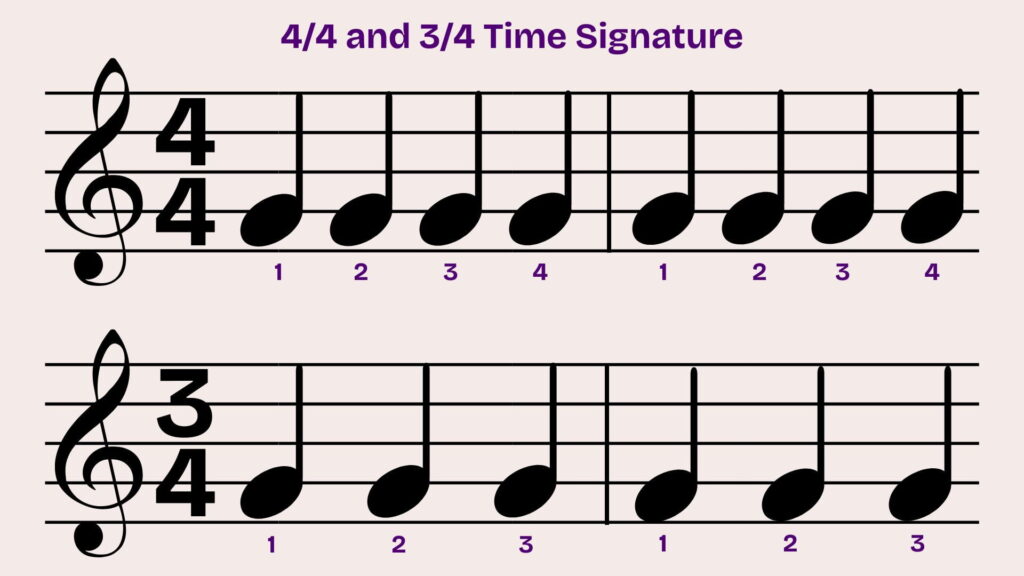
Time signatures are the numbers you see at the beginning of a piece of sheet music. They tell you how many beats are in each measure and what note value constitutes one beat.
Common Time Signatures
- 4/4 Time:
The most common time signature, also known as “common time.” There are four beats per measure, and a quarter note represents one beat. This steady, even rhythm is the foundation for countless songs. - 3/4 Time:
Typically associated with waltzes, this time signature has three beats per measure. The strong-weak-weak pattern creates a graceful, flowing movement that invites you to engage in the music.
Interactive Rhythm Exercises
Exercise 1: Clapping the Beat
- Step 1: Start by tapping your foot steadily. Count “1-2-3-4” aloud for a measure in 4/4 time.
- Step 2: Clap on each count, ensuring your claps align with your foot taps.
- Step 3: Switch to 3/4 time by counting “1-2-3” and clapping accordingly.
Write down how each time signature feels – does one feel more natural than the other? How does the rhythm influence your mood?
Exercise 2: Tapping Out Rhythms
- Step 1: Choose a simple rhythm pattern (for example, a sequence of long and short claps).
- Step 2: Use a metronome or a steady beat app to maintain a consistent tempo.
- Step 3: Practice tapping out the rhythm pattern, then try to replicate it on the piano.
Reflect on how internalizing the beat improves your coordination and timing when playing.
Bringing It All Together
Key take away from the chapter:
- Count Beats: Develop the skill to count beats, which will be needed in different time signatures.
- Understand Time Signatures: Familiarize yourself with how 4/4 and 3/4 time impact the way music is structured and how it sounds.
- Internalize the Rhythm: Practice exercises that build your sense of timing, making it second nature to feel and express the pulse of the music.
Dedicate a few minutes at the beginning of each practice session to rhythm exercises. Use a metronome, clap out beats, and gradually incorporate these rhythms into your playing. Over time, this focus on rhythm will deepen your musical expression and timing accuracy.
Spend a few minutes at the start of each practice session working on your rhythm. Use a metronome, clap out beats and slowly add these rhythms to your playing. As you cultivate this rhythmic-focused practice, over time it will help deepen your musical expression and timing.
Happy practicing and may every beat you count echo the pulse of your passion for music!